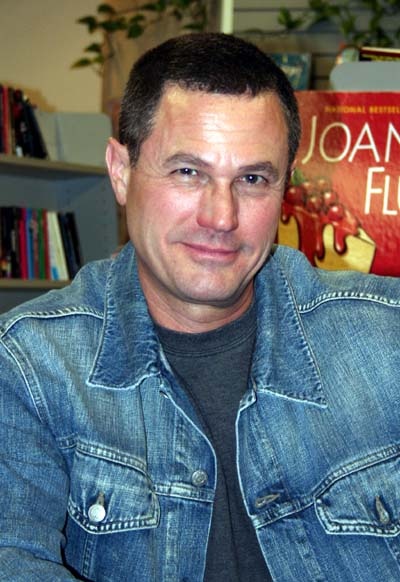
“The Wishbones” by Tom Perrotta

perrotta

By Ray Sawhill

We’ve seen all too much fiction that treats our supposedly postmodern woes — family “dysfunction,” men who won’t grow up, etc. — in solemnly self important tones. Finally, here’s a novel that takes a look at these subjects and does so comically and open-endedly. Tom Perrotta’s “The Wishbones” (Putnam) is like an early Jonathan Demme movie — low key, fond of American forms of eccentricity, and peopled by loony self starters.

It’s basically a scuffed-up romantic comedy. Dave is 31 and still rooms with his parents in their suburban New Jersey home. He’s had the same girlfriend, Julie, for 15 years, and he lives for his weekends playing guitar in a rock band; the big time may have happened to someone else, and the Wishbones may perform mostly for wedding receptions, but Dave still thinks of himself as a rock musician. One night, he almost unintentionally suggests to Julie that they finally get married. She accepts delightedly, then says exactly the wrong words: “there are other things in life besides playing music” — ie., she wants him to herself on Saturday nights. As the wedding preparations proceed, Dave’s life takes a nosedive. A d.j. who spins discs at parties starts to underprice the local bands. Dave stumbles into an affair with a Downtown poet; she has her own troubles. When one of the women he’s made unhappy tells him not to talk to her anymore because “It just makes it worse,” Perrotta writes: “Dave knew better than to ask her to clarify her pronouns.”

Perrotta sets the novel in a landscape of pizza joints, cloverleafs, and chain motels. His characters, their brains equally innocent of zoning laws, are resourceful and animated, and they keep revealing unexpected sides. A guy Dave imagines to be his nemesis turns out to be smart and likable; banal, sweetly bourgeois Julie adores the song “Cocaine.” Perrotta’s special comic tone is slow-burning, rueful acceptance. When Dave anxiously asks an older buddy about being a married man, the buddy says: “I got a house, a wife and kids, and a job that doesn’t make me want to buy a gun and go wreak havoc at the mall. I get to play music on the weekends and drink a couple of beers every once in a while. Things could be worse, Daverino.”

Perrotta may work as a creative writing teacher at Harvard, but he isn’t above doing some actual research; the wedding-reception and wedding-band lore he supplies add a lot to the book’s lived-in texture. And if no-win predicaments keep coming at Dave from out of nowhere, so do happy surprises. One night, drunk and pleased with life, Julie tugs open Dave’s belt. “In the whole pantheon of sex,” Dave reflects, “almost nothing beat a blow job when you least expected it.” “The Wishbones” is a hybrid of the rhymed and the unplanned — a small-scale comedy of accomodation and unresolution that’s full of loopiness and warmth. Like “Bad Haircut,” Perrotta’s 1994 collection of stories, it’s a minor work but a major pleasure.

©1997 by Ray Sawhill. First appeared in Salon magazine.

“Time and Tide” by Edna O’Brien

edna

By Ray Sawhill

“Time and Tide” (Farrar Straus Giroux), the Irish writer Edna O’Brien’s 11th novel, is her harshest yet most beautiful work. She has a touchy, rich theme: the sexuality of the bond between mothers and sons. In D. H. Lawrence’s “Sons and Lovers,” this was seen from the son’s point of view; here, it’s seen from the mother’s. O’Brien’s heroine, Nell, has fled her Irish country upbringing, moved to England and married a stern, angry man. In the course of the novel, she leaves her marriage and finds her way among the constricted English.

A lusciously indulgent mother, she looks to her two sons for a kind of enduring entanglement they can’t give her once they’re no longer small children. She “let them get away with murder … they were her stronghold.” The boys adore her yet finally have to shut her off. You sense how distraught this makes Nell, and experience her feelings and needs while registering how she drives people from her. Even after her sons go to boarding school and she has romances and adventures of her own, the boys are the center of her life; she covets their approval like an anxious lover. O’Brien brings together the earthy and the delicately poetic: she has the soul of Molly Bloom and the skills of Virginia Woolf.

© 1992 by Newsweek, Inc. Reproduced by permission.

“South of the Border, West of the Sun” by Haruki Murakami

Haruki Murakami

By Ray Sawhill

Haruki Murakami’s new novel, “South of the Border, West of the Sun” (Knopf), has little of the deadpan daring of his 1989 “A Wild Sheep Chase,” or of such later works as “Dance Dance Dance” (1994) and “The Wind-Up Bird Chronicle” (1997). “South of the Border” is narrated by a successful though vaguely unhappy jazz bar owner named Hajime. Once, as a child, he’d had a perfect friendship, with a crippled girl named Shimamoto. But he moved away, and he has gone on to break some hearts, marry, prosper and lose his ideals. Then, as in a scene from a movie (Murakami leans heavily on “Casablanca” throughout), Shimamoto walks into one of Hajime’s clubs, flourishes a cigarette and asks for a light. Hajime starts to feel whole again — yet not quite. The passing of time and the shame of betrayal keep getting in the way. And anyway, is this new, grown-up Shimamoto real or a phantom summoned up by need and imagination? It’s “Brief Encounter” for the New Age.

American writing schools may overdo the injunction always to show and never to tell — our young writers seem to know how to do little but show us things — but it’s advice that Murakami could have used. An amazing amount of this book is devoted to Hajime’s discussions of what Shimamoto means to him, what his wife means to him, what his predicament means to him. It’s possible that Murakami is playing changes on a Japanese genre I’m unfamiliar with, or that he’s needling Hajime’s narcissism in ways too Japanese for me to perceive. And he does have a wonderful way of making the novel’s action seem to play out against a background of serenely classical Japanese art. But he also seems determined to baby his imagination. For example, Hajime tells us of his delight in his rapport with Shimamoto. Yet here’s a typical exchange:

“You mean we’re lovers?”

“You think we’re not?”

I catch the echoes of ’40s weepies. It’s what those echoes ought to be bouncing off that’s missing.

If you’re unfamiliar with Murakami’s work and want to give it a try, start with “A Wild Sheep Chase.” A melancholy yet irreverent phantasmagoria about an ad guy, a girl with beautiful ears, a mysterious sheep and Japanese guilt over World War II, it suggests a 21st century cross between “Absalom, Absalom!” and “Mothra,” and it’s still fresh and moving. My guess is that in this zingless new novel, the writer thinks he’s using Hajime’s tale to wrestle with what Thomas McGuane once called “the sadness-with-no-name,” a forlornness many baby boomers fall prey to and can’t shake off.

But his approach — hunting endlessly for the emotion’s metaphysical and historical meanings — pays off only in Rolling Stone magazine-style banalities. Recalling the end of his ’60s college days, Hajime tells us, “Like a drooping flag on a windless day, the gigantic shock waves that had convulsed society for a time were swallowed up by a colorless, mundane workaday world.” While the significance of it all piles up and the action drifts, the annoyed reader may start to wonder: Does Murakami really think that no one before his generation ever got scared of middle age, asked what life is all about and did a little screwing around in search of an answer?

©1999 by Ray Sawhill. First appeared in Salon magazine.

Terry McMillan

mcmillan

By Ray Sawhill

Bookstores had never before been home to anything like Terry McMillan’s tour to promote her 1992 novel, “Waiting to Exhale.” Her appearances attracted mobs of ardent female fans. And when she performed passages from her book, the stores turned into call-and-response arenas, with women standing up to testify to their feelings and shout out their likes and dislikes. This was one writer who had hit a nerve. (Inexplicably, the listless 1995 movie adaptation stirred audiences up as effectively as the book had.) A soap opera about four black women in Phoenix — their jobs, their hair, their two-timing no-good men, etc. — the book is one of those innumerable women’s novels in which friends, through all their ups and down, check in with each other periodically, and together and alone watch life’s cycles wheel by. In white hands these days, this is almost always a spent form. With her bawdy humor and unashamed pride in achievement, and with her relish for fleshly and material pleasures, McMillan brought it rousingly back to life. There aren’t many middlebrow page-turners that offer anything like her frankness and sass.

Her success helped trigger off a still-running controversy about whether or not black women writers beat up on black men. (They often do, and sometimes do so entertainingly). It also alerted the publishing industry to the existence of a large group of underserved readers hungry for fiction in which they could see their own lives. The industry responded promptly, and, since then, works from what might be called the “You go, girl!” school of fiction (Bebe Moore Campbell, J. California Cooper) have become a staple in bookstores and on bestseller lists.

McMillan’s first two novels — “Mama” and “Disappearing Acts” — are also lively airplane reads. (Avoid her most recent effort, the dizzy “How Stella Got Her Groove Back,” unless your appetite for breathlessly narcissistic gab is really epic). If you’re in the market for something similarly female and full-bodied, why not try the marvelous Lee Smith, who writes lyrically about white mountain folk, or that sturdy entertainer Susan Isaacs, who writes humorous mysteries about Long Island Jews?

©1999 Ray Sawhill. First appeared in The Salon.com Reader’s Guide to Contemporary Literature.

“Nobody’s Angel” by Thomas McGuane

mcguane

By Ray Sawhill

In his new novel, “Nobody’s Angel” (Random House), Thomas McGuane tries to get beneath the surface of hip nonchalance. His early books — “The Sporting Club,” “The Bushwhacked Piano,” and “Ninety-two in the Shade” — were literary stunts performed with an attitude of stoned obliviousness that gave them a mocking pizzazz. In their best passages, McGuane seemed to have perfected his own kind of aristocratic cool — evasive and laconic and loaded with crafty surprises. “Nobody’s Angel” is full of his usual pop-surreal situations and wacko characters, but it shows a new willingness to try to look them in the face; it represents an attempt to bring direct emotion into his fiction. If the novel doesn’t work, it’s because he doesn’t go far enough. When desperation and terror are demanded he manages to beckon forth only their pallid stand-ins: timidity and skittishness. The book seems abashed: apologetic, even repentant.

McGuane’s hero is Patrick Fitzpatrick, 36. Ex-juvenile delinquent, ex-prep-school student, ex-Army captain in Germany, where he chased Frauleins and raced his high-speed tank, he has suddenly been overcome by melancholy. Time to grow up, he decides: “By your late thirties the ground has begun to grow hard. It grows harder and harder until the day that it admits you.” He returns to his family’s Montana ranch, and what he has so diligently avoided all these years — grief, guilt, remorse, pain — catches up with him.

Patrick tends his grandfather, a dotty cowpoke, and his loony sister, and feels exhausted, depleted, bewildered; he’s afflicted with what McGuane calls “sadness-for-no-reason.” He has the side-stepping, wise-guy reflexes of a McGuane hero built into his system, but it has come to the point where they rather appall him. Self-consciousness has him in a stranglehold. Under the vastness of the Western sky, Patrick indulges his taste for wistful reverie, consoles himself with booze and waits for a new, more congenial value system to descend upon him. At a party he meets Claire, a young Oklahoma woman who’s beautiful, oil-rich and married. The action moves between Patrick’s attempts to keep his family and ranch shipshape and his struggle to find the emotional wherewithal to woo and conquer Claire.

McGuane gives Patrick plenty of reasons to feel bad, but he hasn’t located and released his hero’s latent energy; the awful, lurking rage of true misery is missing. If you’re going to show a burnt-out case reviving his flame, giving him some fuel doesn’t hurt: remember the Bill Murray comedy “Stripes”? But McGuane wears his literary skills like a surgeon’s mask — Patrick seems anesthetized by the fastidious wordplay. So a vexing question hovers over much of the book: why should a honey-haired dream like Claire bother with a morose loser like Patrick? Even his desire for her seems willed. And McGuane’s writing gets wispy and precious when he lets the couple make love; the sex they have is so hushed and reverent it would go unnoticed in a church. Readers with a horror of sappiness know enough to run for the hills when a put-on artist tries in all sincerity to be sincere, especially about love.

©1982 by Newsweek, Inc. Reproduced by permission.

“True Story” by Bill Maher

maher

By Ray Sawhill

Bill Maher’s “True Story” (Simon & Schuster) is a true curiosity, a book by a popular hotshot (in this case the host and producer of TV’s “Politically Incorrect”) that isn’t an autobiography or a transcribed routine. Instead, it’s an episodic novel about a group of standup comics back in 1979 and 1980. New York City might be a fast-decaying relic, but the standup scene is prospering. Headquarters is The Club, an Upper East Side dive where the fellows go to “work out,” impress women, booze, agonize about their careers, and indulge in obscene-joke shootouts. Every now and then one of these hotshot-wannabes takes a gig in the sticks and shows the rubes a thing or two. Every now and then the rubes show the city boy a thing or two of their own.

At first, the book seems an underdramatized blur. It’s all observations, more a description of a novel than the novel itself. And while the writing has the top-this rhythms of standup, its tone is morose, in a guy-taking-stock-of-his-life way — perhaps because Maher wrote the book in the early ‘90s, between his years as a standup and when he developed “Politically Incorrect.” But Maher has a gift for guys-are-like-this / gals-are-like-that riffs, and the more he complicates the lives of his main characters with love and sex, the more his overgrown boys become distinctive.

And, in the book’s second half, he comes through with a handful of well-conceived scenes. One of them — a comedian-has-an-epiphany chapter, not an easy thing to carry off — delivers an impressively maudlin-yet-bitter wallop; it should be used as a shillelagh with which to tease oversensitive creative-writing students. The creepy competitiveness, the behind-the-scenes lore and the raunchiness all start to work, supplying a texture that’s rank and seductive.

At its best, the book suggests a half-baked cross between “Diner” and “Sweet Smell of Success.” Maher fans should enjoy it. So should anybody who’s fascinated by the standup life, as well as readers who like to fantasize about the movies good screenwriter / director teams might shape out of raw but rich material. Robert Getchell and Martin Scorsese, who worked together on “Alice Doesn’t Live Here Anymore,” are you listening?

©2000 by Ray Sawhill. First appeared in The New York Times Book Review Section.

“The Client” by John Grisham

grisham

By Ray Sawhill

Reading the bestselling novels of the young ex-lawyer John Grisham is like being privy to the conversations ambitious middle-Americans have with themselves. I’ve never read any fiction, including porn, romance novels and comic books, that’s so completely unself-aware, and I’ve never read a writer who’s less aware of his effects. He’s the Dan Quayle of novelists. His books are strangers to such concerns as shape, theme, character, and form; there’s nothing in them to wrestle with in the way of meaning.

It’s fiction for people who don’t normally read fiction by a guy who isn’t much drawn to it himself, except as a business proposition — as an effort to score a bonanza. But the books don’t seem to be experienced as cynical by his fans. (Is it because they too understand the world largely as a mass of business propositions?) His novels are for and of a world where making it is everything. Reading them is a little like watching game shows, except his novels are for people with college educations rather than working-class people. Grisham offers a little suspense, a little sexual temptation, and some money-and-job details to relate to.

The guy isn’t a genre craftsman, and the books aren’t exactly formula novels. At the same time, these suspense novels are an entertaining treasure trove of unwitting Dadaism. But where Dada was European and sophisticated, this is homegrown and inadvertent. The Dadaists were conscious artists purveying an idea of the unconscious. Grisham’s books are the unconscious. They don’t exactly express the ambivalent feelings many Americans have towards sophistication, but those feelings are certainly in them.

Grisham’s novels — he has written four so far and more than 19 million copies are in print — are full of scrambled syntax and crazy names, but there’s nothing of the puzzle-maker about him as a writer, and there’s nothing in the books that’s meant to be broken down or analyzed. Relationships dart in and out of the narrative frame in a way that, without meaning to, recalls Queneau. “Klickman was a meathead with little finesse,” the narrator of Grisham’s new novel “The Client” (Doubleday) tells us. Two pages later, the main character, an 11-year-old boy, apparently struck by what a great word choice the narrator made, begins a lecture to Klickman (a cop) this way: “Let me tell you something, meathead.” Within another couple of pages, the narrator, evidently pleased the 11-year-old enjoyed the word “meathead,” takes to calling the cop “Meathead Klickman.”

Listen to the Grisham narrator:

  • “Mo had at least four guns either on him or within reach.”
  • “He paced around the office as if in deep thought.”
  • “His screaming lungs were almost audible.”
  • “At some point, about halfway to the jet, Mark stopped.”

Sentences like these can really get you thinking: If the narrator doesn’t know, who does?

The idioms the narrator uses often seem to come from Mars. One character “cracks his window so he could breathe.” Another “cuts his eyes in all directions.” A singer in a black church opens her “vast mouth” and out flows “a deep, rich, mellow river of glorious a capella.”

At times you find yourself wondering if Grisham is trying to compete with Lewis Carroll:

“The name’s Reggie, okay.”

“Sure, Reggie. Listen, K.O. just brought me up to date.”

Even allowing for some attempts at comic characterization and for how eccentric names can be in the south, Grisham has the most topsy-turvy ear for character names imaginable. Nearly all are like something S.J. Perelman invented for a Marx Brothers movie: Cat Bruster, L. Winston Lotterhouse, Gavin Verheek, Gray Grantham, Fletcher Coal, Denton Voyles, Eric East, Clint Van Hooser, Smith Keen, Hinky Myrick, Mason Paypur, Willis Upchurch, Paul Gronke, Emmitt Waycross, Norma Thrash, Link Dole, Dr. Wilbert Rodeheaver.

In “The Client,” Grisham outdoes even himself in the name department, showing a completely inexplicable fondness for names with repeating letters: Boyd Boyette, Roy Foltrigg, Reggie Love, Penny Patoula, Chester Tanfill, Walter Deeble, Slick (Mole) Moeller, Marcia Riggle, Omar Noose. In a virtuoso touch, a few characters win names with double sets of double letters: Wally Boxx, Barry Muldanno, Skipper Scherff.

When a couple of thugs hole up at a Radisson Hotel, it certainly seems like the right place for them. And when you learn that the lead character adores pizza, you’re relieved — it’s the right food for him. If you look for a Nabokovian pattern of linguistic playfulness here, you won’t find one. You end up wondering: is this a tick that comes from Grisham’s years in Mississippi and Tennessee? The names contribute to sentences that really leave you cross-eyed: “He had an escort of sorts with Wally and Fink and agents Trumann and Scherff.”

When Grisham sets out to provide detail and atmosphere, what he achieves goes past the Hemingwayesque into pure corporate-speak. “The lights were bright and the carpet was clean.” “A minister of some generic faith appeared.” “His voice was loud, yet warm. His words were educated, yet colloquial.” “Deacons danced. Elders chanted. Women fainted.”

Reading his novels all at once, you turn up gems for the auteurists. Why, in three of the four novels, is there a black character — always a different one — whose first name is Roosevelt? In “The Client,” as in his other books, Grisham seems drawn to backsides: “Slow on his ass”; “He shifted his wide ass”; “Wally perched his tiny butt”; “He followed her, watching her wide rear end” — all these appear, in the narrator’s voice, within twenty pages of each other. In the first two pages of one chapter we get: “the screaming and ass-chewing had ended hours ago. He’d have the pleasure of busting her ass.”

Grisham’s storytelling is so methodical his novels sometimes have the minimalist fascination of those repetitious passages in Beckett where a character moves stones from one pocket to another. At these moments, the books seem more akin to office supply catalogues than to traditional fiction.

I don’t know what to make of the fact that the main character has gotten younger in each of the books. In “A Time to Kill,” he’s a lawyer in his early thirties; in “The Firm” he’s a new hiree; in “The Pelican Brief” it’s a woman law student. In “The Client” it’s the 11-year-old boy. Is there anything to make of this? Grisham’s scrambled narrative voice — a potpourri of steals from movies and TV shows, premature wise-guy cynicism and self-pity — and the main characters do synch up a little better in “The Client” than in the earlier books.

But it’s almost impossible to understand what the central plot of the novel is. The setup is clear: a mob lawyer is trying to commit suicide. The boy tries to foil him. Drunk and morose, the mob guy tells the kid where a dead senator’s body has been buried, then manages to do himself in. But the rest of the book! The only thing that keeps it from shutting down entirely is that the boy can’t decide whether or not to tell anyone his secret.

That said, it’s easy to understand why, when you board a plane and walk to your seat, you see so many businesspeople reading a Grisham novel. The books are guileless expressions of America’s middle class. They aren’t middle America as seen and expressed by an artist; they’re middle America entertaining itself. A Grisham novel is cousin to those catalogues you find in the seat pockets of airplanes advertising desk accessories, leather business-card holders, fold-up luggage carts, pool floats and dopey gifts for the kids.

It’s bewildering, if rather sweet, in “The Firm” that the book simply assumes we’re going to identify with its main character — a nice guy, a little competitive maybe (Grisham’s concession to the fact that the guy’s actually a shark), who just wants to make money. He wants to achieve this by doing tax law, and we’re expected to say: Smart move, I can see doing that myself.

What’s on many millions of people’s minds is right there on the surface in these books. Nothing has been digested, nothing transformed. They’re as genuine and true to themselves as the work of what are usually thought of as folk artists, only the culture they issue from — middling colleges, suburbia, a couple of cars, concerns about savings plans and office politics — isn’t what we’re accustomed to thinking of as a folk culture. Even the suspense-novel frame has a middle-American purity. Grisham has spoken about learning how to do suspense from an article in Writer’s Digest: it’s a matter of lots of dialogue and action; creating a main character for people to identify with; trapping him in an evil conspiracy; closing things in around him; then getting him out.

What he puts in his books is exactly what’s in the air when you’re among hustling middle Americans. He’s one of them; he’s their boy. Here’s some of what’s in the novels:

  • The desire of middle Americans to retire early to someplace sunny.
  • Their attachment to seeing themselves as wised-up former idealists, although all they’ve ever really cared about is making money.
  • The vindictiveness they have towards media liberals, experts, technicians — “sophisticates.”
  • Their feelings of betrayal and aggrievedness. They once hoped they’d enjoy their job, and it has turned out to be a bore, and the people at the office are greedy creeps.
  • The way they live well but always feel anxious about money.
  • Their mixture of priggishness and lasciviousness. Even while they’re giving each other the eye, expressions of disgust — towards politicians, towards the aged — keep popping out of them.

The novel of his Grisham has said he cares most about is his first, “A Time to Kill.” The book involves his hero’s feelings about a case he has taken on: defending a black man accused of murdering two rednecks who raped his 10-year-old daughter. What Grisham’s hero feels angriest about is that he isn’t getting paid much for the case — which he has taken not because of any feelings about justice (it’s assumed we all agree that some people, in this case the rednecks, just deserve to die), but to get noticed.

He worries that the case will be stolen from him by a more famous lawyer. When it is, he berates the black prisoner for having ditched him in favor of the big-timer, and we’re expected to side with the main character in this scene — to agree that he’s being treated outrageously. He wins the case back — worrying some about the ethics of this — then blows a major part of the trial. He gets drunk. He stares at himself in the mirror. He pulls himself together for a winning, touchingly sincere final speech to the jury. (It’s perfect that Tom Cruise — master of willed ingenuousness — will be the first onscreen Grisham hero.) Our experience with novels leads us to expect “criticism” of such a hero for his inability to care about others. Here, the criticism never comes. The entire point is what he goes through to nail this case — essentially, to advance his career.

As a fantasy, this story is central to all of Grisham’s books. Sexually, what happens is: the Klan starts to make threats, and the main character sends his wife and daughter to his parents’ home. Instantly, a beautiful, liberal, intellectual, bra-less northern law student volunteers to assist on the case — she’s from Boston but is at school at Ole Miss. She buys beer and trades wiseass banter; she looks swell in her jeans (offering a fetching “rear view”). She does research — and her best to seduce the hero. She wants it; he does too. When things really warm up between them, she gets kidnapped by the Klan.

The scene where the Klan tortures her is the sexiest passage in Grisham, if you’re open to responding that way to this kind of thing. She’s tied facing a post in front of a burning cross. Her blouse, skirt and underwear are ripped from her back — bottom alert! The robed ones threaten to whip her; they chop her hair off and release her.

She’s alluring, she handles the complexities of the law more confidently than the hero can, and she’s a little too fast for him; she threatens to take him away from the mother-wife. So the Klan rises up and punishes her, because finally what she represents is “all crap” — one of Grisham’s, his narrator’s, and his characters’ favorite terms. The hero’s achievement in the novel is that he wins the case and he doesn’t fuck the northern girl.

Two key sentences appear in “A Time to Kill”: “he had never won an argument, in court or out, with an expert witness,” and “the embarrassment turned into anger.” These sentences express Grisham totally as a writer: resentment towards expertise, technique and sensitivity, and towards any perspective on his feelings about things.

The only other scene in Grisham that has any sexiness at all is in “The Firm.” The hero is in the Caymans, disapprovingly helping his boss launder some money, and (disapprovingly) watching the older man make out with young women. The hero rejects the advances of a few girls — rather nastily, as though their wanting to frolic made them disgusting. But then he has a few drinks, and a cute, mischievous girl in a bikini top and sarong lures him down the beach. They’re alone, it’s warm and the water is seductive. She unwraps the sarong and — she’s wearing not just a bikini bottom but a string/thong. He can’t resist playing with that string…For the rest of the novel he’s upset because he couldn’t resist fucking her. He wonders whether he should confess to his wife; we learn shortly that the beach girl was part of a conspiracy that’s entrapping the hero.

The central fantasy in all Grisham’s books is of being on the verge of puberty, getting a look at adulthood — yech, when that string comes off, it’s confusing, it’s disgusting — and managing to leap over it to a wonderful retirement where you still have your youth and looks. (This is adulthood as seen by a young boy: a matter of corruption, spies, conspiracies, wiretaps. The great thing is to outwit adulthood and get away with it.) Glimpsing power and sex, you return to Mom and escape with her to the sun, where bottoms are clean, plump and fresh –where they do nothing but arouse, and are wrapped up enticingly, like gifts and candies. Given that, it’s almost surreal to learn from published interviews that as many as two-thirds of Grisham’s readers are women, and also that he regrets having let his hero fuck the girl on the beach.

  • Buy a copy of “The Client.”
  • Francis Coppola’s film of Grisham’s “The Rainmaker” ain’t half bad. Buy a copy.
  • Though many people hated it, I loved Robert Altman’s atmospheric and satirical Grisham takeoff, “The Gingerbread Man,” starring Kenneth Branagh doing a great take on Bill Clinton.

©1993 by Ray Sawhill. First appeared in The Modern Review.

“Lullaby Town” by Robert Crais

crais

By Ray Sawhill

Elvis Cole, the hero of Robert Crais’ “Lullaby Town,” does business the California way — it looks like casual recreation to people from less forgiving climates. The genre hasn’t spawned a purer example of mankind in its L.A. incarnation than Elvis. When friends visit, he puts salmon and eggplant on the grill. His wisecracks usually include a movie reference. His detecting skill is always ready to be called on. But why make a big deal out of it?

In “Lullaby Town,” Crais’ third private-eye novel, Elvis is hired by a film director to find his ex-wife and child; the search leads to rural Connecticut and into the heart of a Manhattan mob family. Shivering in the cold and wincing at the filth, Elvis is unable to understand why anyone puts up with life in the Northeast. But he gets to the brutal heart of things in his own way, and he and his ninja-style partner make an impressive team. In terms of lethal efficiency, they’re a match for the bullet-spraying East Coast goons.

Crais has a reader-friendly style, and he’s a meticulous craftsman; the relaxed-seeming plot keeps paying off with scenes of surprising tension. Supple and low key, he’s actually far better at the private-eye-novel racket than most writers who make a loud point of being down and dirty. He gets the job done without losing track of the pleasure.

© 1992 by Newsweek, Inc. Reproduced by permission.

Raymond Carver

carver

By Ray Sawhill

Writing in the 1960s was generally a matter of exuberance, insolence, drugs, and experimentation. Raymond Carver, who began publishing his terse short stories in the 1970s, helped bring fiction back to small facts, won with difficulty and painfully expressed. As he became better known, readers grew familiar with “Carver people” — aimless and bewildered blue-collar souls between marriages and between jobs — and “Carver’s world” — all stray ends, polluted streams, and rooms rented from widows. He was celebrated as the leader of a school of “minimalist” fiction, and was often described as America’s Chekhov, delivering not the corniness of mere stories but the real stuff itself: what comes between stories. For a few years, talk was abroad of a Carver-led short-story renaissance. By the time he died — at the age of 50, in 1988 — he was probably the most influential literary writer in the country.

Though he didn’t hide from the press, Carver became as mythical a figure as Salinger or Pynchon. He had worked at dead-end jobs, he was an alcoholic, and he smoked too much, too; lung cancer was what finally killed him. In photos, he didn’t look like a writer, he looked like a laborer — so, for some, he became a saint of authenticity, telling us the straight dope about stunted, one-day-at-a-time lives. The fact that he kept to short forms (essays, poems, stories) enhanced the myth: such brutal honesty about such hard truths could hardly be asked to fill out looser forms. He was so securely canonized that by 1993, when the filmmaker Robert Altman was publicizing “Short Cuts,” his adaptation of a number of Carver stories, he did so in the company of Carver’s widow, Tess Gallagher, and spoke often about his feelings of inadequacy in the face of his material.

Some of the stories do have an ugly power. If you’re in the mood for a downer, “The Calm” and “So Much Water So Close to Home” should hit the spot. And Carver’s touch with humor — particularly of a sad-one-moment, pugnacious-the-next, headed-nowhere-fast kind — is usually skillful. But most of his writing is mannered. The repetitions signifying a stumbling exasperation (“Will you please be quiet, please?”), the sentences that start on a high note only to give way beneath you, the foot-dragging rhythms, those not-an-epiphany epiphanies … It gets to seem mighty gimmicky mighty fast.

And since he repeatedly said that he wanted to be thought of as a realist, not a minimalist, maybe we should ask: who are these “Carver people” who do nothing but brood, drink, and watch their lives fall apart? For his fans, of course, Carver nailed the essence of loser America. But if you strip people from any class of their pride and energy, it’s inevitable you’ll be left with little but despair. It’s hard not to find his work monotonous and bathetic: all that booze, all those cigarettes and lonely failures to connect, that tenderly-highlighted inarticulateness. Carver flattens out his characters and their lives, then invites us to admire how humane and truthful he’s being. Story after story wants to do little, finally, but wipe you out and make you feel desolate — to give you a good, long look at the raw nothingness of it all.

How then to explain his reputation? It may be that, for writing students, Carver’s (easily mimicked) approach suggested a quick way to achieve the appearance of heavy truth. A little misery here, a broken family there, an awkward attempt at god knows what before all dissolves into entropy once again — voila, Insta-Depth. And for readers? My guess is that, for some of them, “literature” is a kind of faith always in danger of succumbing to evil forces (mammon, vulgarity, indifference). For such readers, Carver’s stories-which, if you buy into them, have an aura of misery reluctantly illuminated by shafts of radiance — can be occasions for worship and prayer, religious services for those still hoping for redemption by art.

The Carver myth of course wasn’t Carver’s fault. He did indeed grow up working-class, and he did know tobacco and alcohol all too intimately. But by his own account he was a bookish, sensitive guy who had wanted to be a fiction writer from his teens. He studied writing at a number of colleges, did a stint at the Iowa Writer’s Workshop, and spent much of his life as a teacher of creative writing. He worked closely (as the journalist Dan Max has shown) with the editor Gordon Lish on shaping his early stories for maximum lit-world impact, and won many big-deal prizes and grants. We might do better, in other words, to remember him as a writer, not an oppressed hod carrier, and as one who did remarkably well for himself.

The easiest way to sample Carver is to pick up “Where I’m Calling From,” an anthology of the stories he considered his best. If you want to explore further, try the individual collections. His early stories, gathered in “Will You Please Be Quiet, Please?” (1976) and “What We Talk About When We Talk About Love” (1981) have a menacing, off-balance feel. The later ones, collected mainly in “Cathedral” (1984), are more relaxed but, perhaps, less compelling. Skip the poems, which are embarassing, and the essays, which are worse.

If your tastes run to the minimal, you’ll also want to sample Anne Beattie, Frederick Barthelme, and Bobbie Anne Mason. If you prefer painful themes churning beneath mundane surfaces, then Richard Ford, Tobias Wolff, and Russell Banks may please. If you’re drawn instead to writers who aren’t so officially sanctioned, you might try Charles Bukowski and Charles Willeford, gifted lower-depths wallowers who wrote with comic-book gusto yet could also summon up currents of bitterness and melancholy. For sweet and funny visions of stray-ends America free of authorial gloom, you aren’t likely to go wrong with the work of Tom Perrotta, William Price Fox, Sarah Gilbert, or James Wilcox.

©1999 by Ray Sawhill. First appeared in The Salon.com Reader’s Guide to Contemporary Literature.